

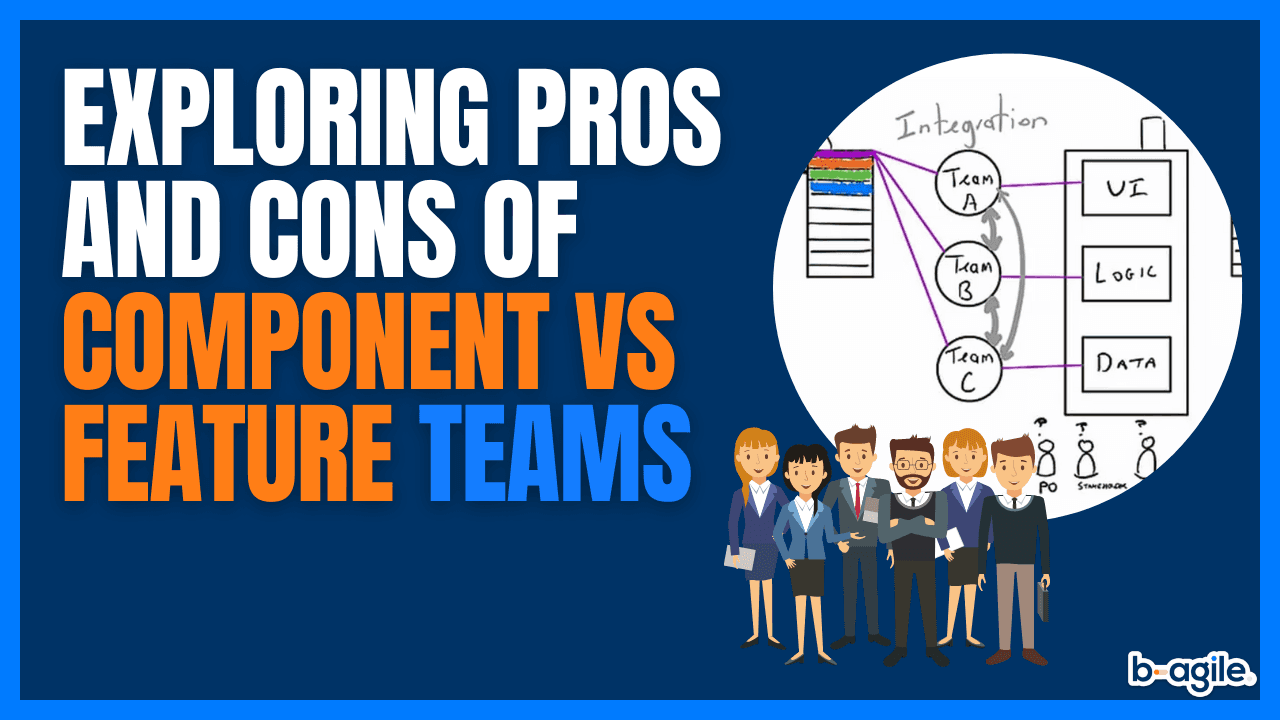
Scrum is the most widely used framework for managing complex problems, and the Scrum Guide is clear on its principles and practices. But it leaves teams with a crucial question: how should a Scrum Team be structured? Specifically, should it be a component team or a feature team?
This post compares the two structures in the context of Scrum, their characteristics, and what each means for your organisation. Understanding the difference lets you make an informed decision about which approach suits your product.
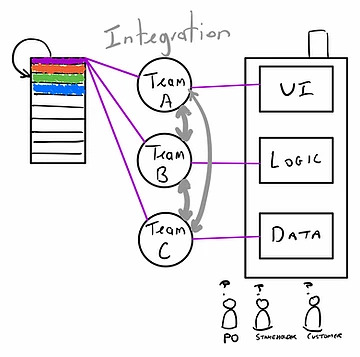
Component teams are:
- Organised around technical layers or technical components.
- Many teams are needed to turn a customer-centric feature on the Product Backlog into a releasable Increment.
- Horizontal slicing: work is divided by technical layer or component.
- Together only for the duration of a programme or project, and often involved in several projects at once.
- Dependent on a lot of coordination to integrate a potentially releasable Increment.
- Hard to read. It is very difficult to understand where we are, so transparency suffers.
- Reliant on project management.
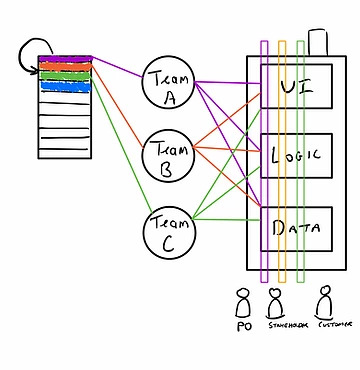
Feature teams are:
- Long-lived, working on many features together over time.
- Cross-discipline and cross-component. Each team has all the skills needed to turn Product Backlog items into releasable Increments.
- Vertical slicing: work is divided by end-user functionality.
- Integrating continuously within each Sprint.
- Transparent. There is no unknown, undone work, and there is a potentially releasable Increment at least once per Sprint.
What component teams do to an organisation
Component teams are sometimes necessary. Make them the exception rather than the rule, because they:
- Lead towards, or reinforce, a waterfall process and keep organisational silos intact: business change, architecture, development, test, operations.
- Lead to water-scrum-fall, something that uses the language of Scrum but definitely is not Scrum.
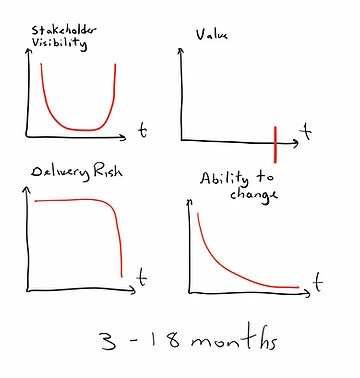
- Delay the release of value, and delay validation.
- Remove end-to-end accountability for the customer, which kills creativity, self-organisation and intrinsic motivation.
- Increase risk.
- Encourage big up-front design.
- Delay learning, and delay functional and non-functional testing.
- Add hand-off waste and delay.
- Hurt work and morale through task switching between projects.
- Accumulate high technical debt.
What feature teams do to an organisation
Feature teams:
- Lead to customer-focused and business-focused organisations.
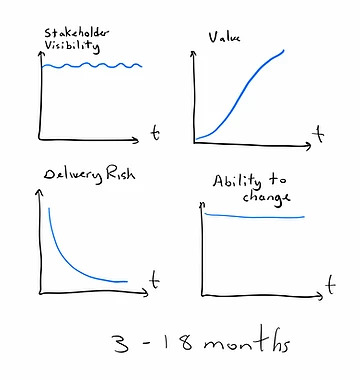
- Lead to iterative, incremental release of value and validation.
- Maximise value.
- Give end-to-end accountability.
- Enable emergent design.
- Encourage creativity and intrinsic motivation.
- Enable self-organisation.
- Promote good engineering practice through shared code ownership: clean code, continuous integration and delivery, refactoring, automation and testing. Higher quality means a lower cost of ownership.
- Reduce risk, by tackling high-risk items early and deploying to production.
- Ensure transparency.
- Give both flexibility and stability.
- Let the organisation focus on the flow of value.
- Let people learn from each other and cross-skill.
Conclusion
Component teams offer specialised expertise, but they reinforce waterfall processes and get in the way of collaboration. The cost is delayed value, no end-to-end accountability, less creativity, more risk, up-front design, delayed learning and testing, hand-off waste, task switching and technical debt.
Feature teams working on complete vertical slices bring cross-disciplinary collaboration, end-to-end accountability and a customer-centric approach. They deliver value faster, with transparency and flexibility. Combine that with effective coordination and continuous learning and your organisation becomes genuinely more agile.
We cover team structure, and much more, on our Professional Scrum Master course.
Go deeper
Professional Scrum Master - AI Essentials (PSM-AI)
Put this into practice with the course that covers it in depth.
View the course