

Two things I see again and again:
- When there is no product vision or Product Goal, there is a distinct lack of focus in the order and contents of the Product Backlog.
- Let's be realistic. If items arrive in your Product Backlog faster than they leave, it grows. Hold on to everything and it goes stale.
Here are a few tried and tested ways to bring focus back to your Product Backlog.
Do you have an inspiring product vision? Does it offer direction?
Product vision. A product vision, or vision statement, describes the overarching long-term purpose of your product for everybody inside and outside the company. Vision statements are aspirational and emotional. They say concisely where the product hopes to go and what it hopes to achieve in the long term.
A few real-world examples of great vision statements:
- Tesla: to create the most compelling car company of the 21st century by driving the world's transition to electric vehicles. Its mission is to accelerate the world's transition to sustainable energy.
- IKEA: to create a better everyday life for many people.
- Sonos: Fill every home with music.
- Google: To provide access to the world's information with one click.
- Instagram: To capture and share the world's moments.
- Uber: To evolve the way the world moves. By seamlessly connecting riders to drivers through our apps, we make cities more accessible, opening up more possibilities for riders and more business for drivers.
- LinkedIn: To connect the world's professionals and make them more productive and successful.
Why a product vision matters
Consider how hard it would be to develop a strategically sound product without one. How would an agile team know where to focus, or which Product Backlog items to order first? On what strategic basis would a Product Owner make decisions?
Set a Product Goal
The Product Goal. A Product Goal describes a future state of the product that can serve as a target for the Scrum Team. It helps drive the emergence of the Product Backlog. (Scrum.org)
The Product Goal is the shorter-term focus as you work towards the product vision.
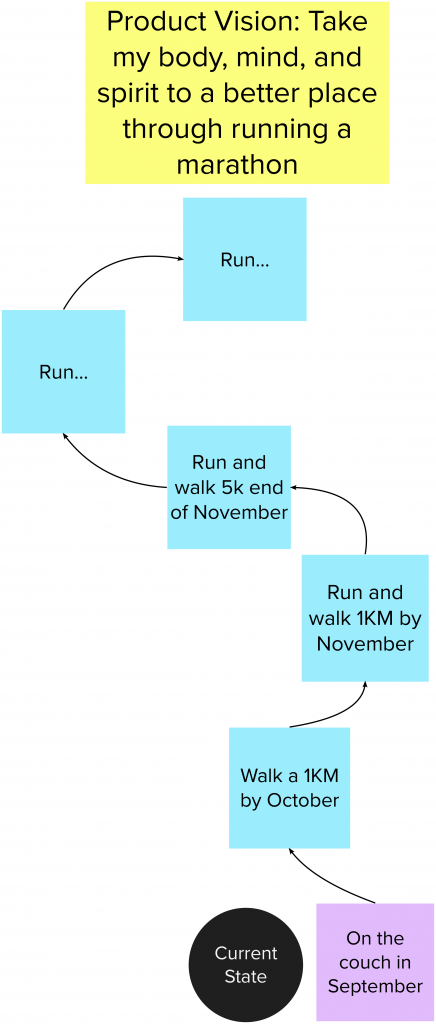
Say your product vision is to run a marathon, and you are currently on the couch. It feels like an insurmountable strategic goal, and it is easy to get lost on the way.
Taking smaller strategic steps towards the vision keeps you focused on the bigger picture while creating highly valuable outcomes for your customers along the way.
Make goals FAST. FAST goals are frequently discussed, ambitious, specific and transparent.
A Product Goal connects the vision to the Product Backlog. The backlog becomes focused on achieving the current intermediate goal. Smaller, tactical Sprint Goals guide the evolution towards the Product Goal, creating a useful, valuable Increment every Sprint to test your assumptions.
Limit the size of the Product Backlog
Limiting the size of the Product Backlog creates focus on the importance of each item with respect to the vision, the Product Goal and your other objectives.
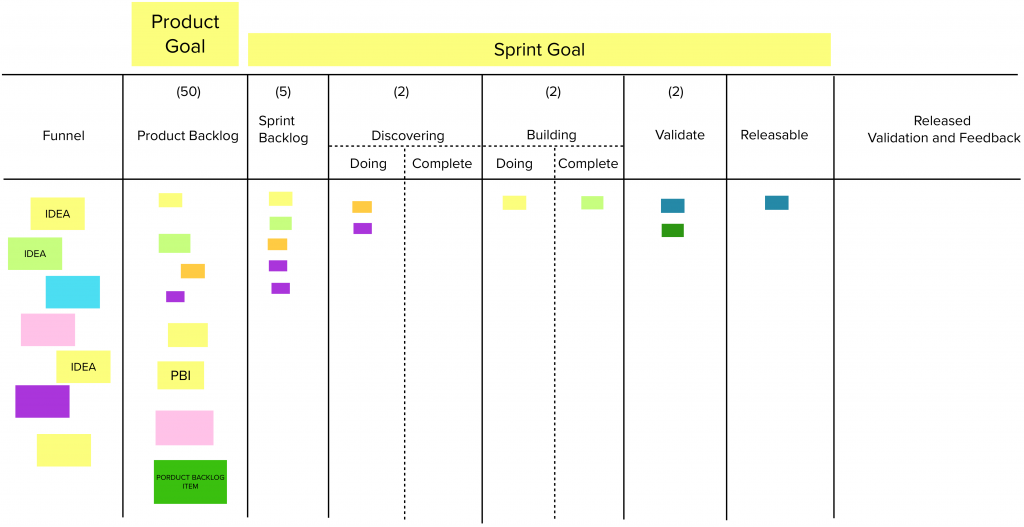
In this example the Product Backlog is limited to 50 items. The limit keeps the content fresh and focused on the current Product Goal. Collaboration in the team becomes more focused and better able to manage for value. This can be part of your Product Backlog refinement.
Use a Product Backlog funnel
In the Product Backlog, or in the bin?
As a further step beyond limiting work in progress, a funnel, filter or sorting hat can assess potential Product Backlog items against the Product Goal and product value before they get in. Items can be weighed by balancing product value against risk exposure.
There are many practices for connecting Product Backlog items to Product Goals. We use a range of them: analysing business strategy, vision storytelling, user story mapping, product value metrics, user personas, impact mapping, and designing and learning from experiments. All of them help assess the potential value of an item. We go further into these on our Advanced Product Owner class.
Refine continuously
The Product Backlog is continuously refined by the team, adding detail, size and order.
Try keeping the Product Backlog up to date and in line with the vision, the Product Goal and your other objectives in real time. If the Product Goal is refined or changes, is the Product Backlog still relevant?
Optimise the flow of value
This is a more complex subject, and a core topic in our agile coaching and our Kanban lab.
By limiting work in progress, understanding and visualising the flow of value and the state of work within it, optimising the size of work items, and reducing unwanted variability, you learn how to experiment with the size, structure and contents of the Product Backlog to improve it further.
Take some time to reflect
Take some notes.
- What will you take away from this post?
- What is emerging for you?
- What has changed, or is changing, in the way you think about the Product Backlog?
- What experiment will you design with your team?
- What have you learnt, and what will you pursue?
- What action will you take?
Questions for me? Email chrisbexon@bagile.co.uk.
On our classes you get far more than content delivery. We work with you to understand your needs, in your business context and with your business examples, as part of an agile coaching conversation. That leads to deeper learning, actions and experiments. Our Professional Scrum Product Owner class is where to start.
Go deeper
Professional Scrum Product Owner (PSPO)
Put this into practice with the course that covers it in depth.
View the course