

Velocity is a historical measure of how much work a team completed in a Sprint. It is used to forecast a range of future outcomes. It is not a productivity metric, a target or a performance measure.
In Estimation isn't broken we argued that the problem with estimation is not the technique but the thinking behind it. The more you do not know, the less predictable things become.
Now let's talk about velocity, one of the most misunderstood numbers in product development. It is not the only option for planning and forecasting, and it might not even be the best. But it is one of the most common we see, so we need to be clear about what it is and what it is not.
Velocity is a result, not a target
Velocity reflects what a team has already completed, usually measured in story points. It is not speed or productivity, and it is not a promise about what comes next. It is something to notice.
Used well, it helps a team answer three questions:
- What do we usually finish?
- Are we consistent?
- What might we forecast next?
That can be enough, if you approach it the right way.
Where it goes wrong
Teams often say velocity reflects past performance. But then they:
- Treat the average like a promise.
- Expect consistency in an inconsistent world.
- Use it to compare teams.
- Tie it to bonuses.
- Forget what it is actually for.
Suddenly velocity becomes a target. Once that happens, estimates get inflated, forecasts get rigid and trust takes a hit.
Most misuse begins when velocity is treated as a commitment instead of a learning signal.
Let's make it real
Two towns, one hundred and forty miles apart. The speed limit is seventy miles an hour. So the journey takes two hours?
Of course not. You are not driving at seventy the whole way. There is traffic, roadworks, time of day, weather, roundabouts and delays. When you plan a trip you do not give an exact time. You give a range based on what you know.
That is forecasting, and the same mindset applies to product development.
Old sat nav versus live traffic
A modern sat nav gives you an arrival time based on what is happening right now. It adjusts constantly and never promises a fixed arrival time. The old ones just used distance and speed.
One helps you make better decisions. The other gives you a false sense of control. If your team uses velocity as a fixed number, you are running with an outdated sat nav. Forecasts should adjust as you learn more.
Use a range, not the average
If you use velocity to forecast, do not just take the average. Use a range:
- Best case
- Typical case
- Worst case
That gives you flexibility and realism, and it turns velocity into a conversation instead of a score.
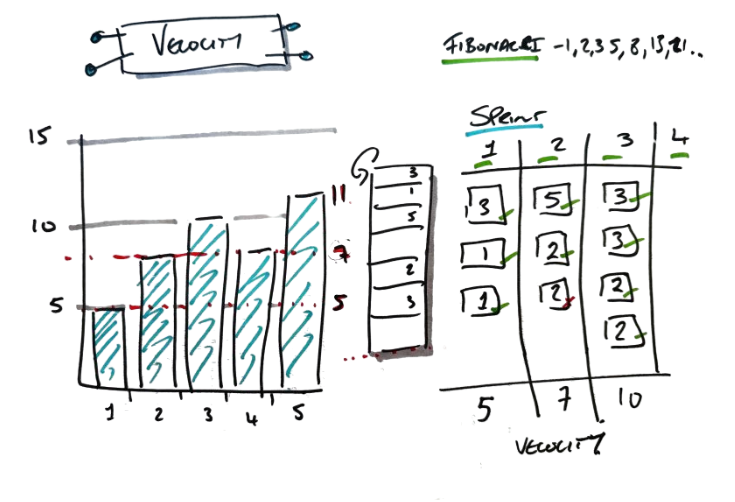
When we support teams we often use this sketch to reset how people think. We ask three things:
- What was your lowest Sprint velocity?
- What was your average?
- What was your highest?
That range says more than any single number. It shows variability and uncertainty, and it reminds everyone that only completed work counts. How that feeds a forecast is the subject of the next post in the series.
Meeting teams where they are
There are more powerful ways to plan, and not every team is ready for them yet. Velocity is what many teams use, so we help them use it well. This post is not here to promote velocity. It is here to explain it, ground it, and help teams move forward with the right mindset.
Used well, velocity builds trust. Used poorly, it creates waste. The number is not the point. The thinking is.
Try it with your team
Pull up your last six Sprints and write down the lowest, average and highest velocity. Then ask: if we had to give a range for the next Sprint, what would we say?
The estimation series
- Estimation isn't broken. The thinking might be
- Velocity. It's not what you think it is (you are here)
- Still using velocity? Make it useful again
- Story points vs reality: what estimation really shows