

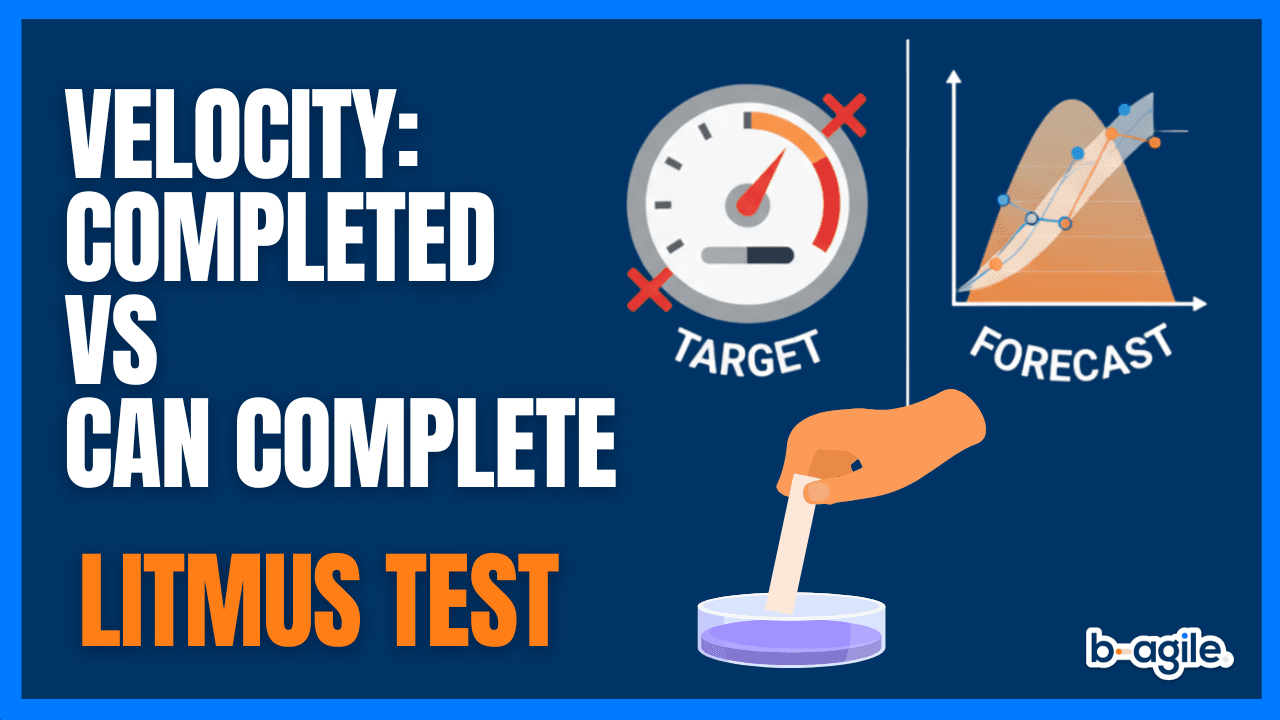
Velocity is a historical result that helps a team reason about future uncertainty. It is not a target, a promise or a measure of delivery performance. If someone describes it as how much a team can complete, they are using the vocabulary without the thinking.
You have been told you are doing Agile. But listen closely and what you hear is not thinking. It is vocabulary: frameworks repeated mechanically and practices copied without understanding why they exist. That is how teams end up playing Agile bingo.
We see it constantly. Organisations say they have been "doing Agile" for years. Then they come to one of our fundamentals courses, and almost everyone says the same thing: "We're not really doing it. We're just using the words." That gap between language and understanding is where most change efforts stall.
This series exists to expose it. Each post uses a simple litmus test, one question that shows whether someone understands the thinking behind a practice or is repeating what they were taught. We start with one of the most misunderstood concepts of all.
Why we created this series
You cannot coach someone out of a fundamental misunderstanding. You have to reset first. That is why we design our training as a reset rather than knowledge transfer: a chance to get the fundamentals right, so real agility has room to exist.
Training alone is not enough, though. People also need to spot shallow understanding when they see it, and recognise when agile language is being used without agile thinking behind it. Each post follows the same pattern. A simple question, a common answer that sounds reasonable but misses the point, why that answer is a problem, what genuine understanding looks like, and why the difference matters. No trick questions. Just clarity.
The question
Ask a Scrum Master or agile lead: "What is velocity?" Then listen carefully. To surface the thinking even faster, follow up with: "How does velocity help you make decisions about the future?"
The shallow answer
The usual reply is "Velocity is how much work the team can complete in a Sprint." Variations are close behind: it shows how fast the team is moving, it tells us how much the team can deliver, it is a productivity measure, we try to improve it over time.
All of these come from the same place, a delivery and output mindset. Notice how every one of them quietly blurs what was completed with what can be expected next.
Why this misses the mark
This thinking treats velocity as a delivery signal, which keeps the conversation anchored in a project mindset. The assumptions underneath are familiar even if nobody says them out loud. Work is something to push through, success is measured by output, predictability comes from control, and value is assumed once enough things are delivered.
Velocity was never intended to validate delivery performance. Used that way it becomes a crude proxy for past activity, and it turns into a target instead of a result.
Once velocity becomes a target, estimates get inflated to protect the number and teams stop being honest about uncertainty.
The rest follows. Forecasts harden into expectations, complexity and variability are ignored, and trust erodes. The Scrum Master drifts into task management and the team optimises for numbers instead of learning. Control replaces curiosity.
That is not a tooling problem. It is a thinking problem, and it is exactly how organisations with a delivery and project bias quietly corrupt practices that were meant to support learning, inspection and adaptation.
The genuine answer
Someone with real understanding says something closer to this: "Velocity is a limited, historical signal that helps us reason about future uncertainty. It is not a measure of delivery performance."
They usually make the limits explicit. Velocity is based on estimate units, not effort or output. It applies to one team in one context, and it is not something to optimise, stabilise or explain. They use it to create forecast ranges, not commitments, and they know its only value is the conversations it enables.
They often add that they never talk about velocity in isolation from value, and that they use it to explore risk, options and trade-offs. As maturity grows they rely on it less, because flow data gives stronger forecasting signals and probabilistic forecasting helps them reason about outcomes, not promises.
At this level velocity is a temporary, imperfect tool to support decision-making, and nothing more. It is also worth knowing that the Scrum Guide does not mention velocity at all. It is an optional practice, not part of Scrum.
Why this matters
When velocity is treated as a delivery metric, teams optimise output. When it is treated as a forecasting aid, teams optimise learning. The shift is subtle but critical: from "Did we deliver enough?" to "What does this tell us about our options?"
Velocity stops being something to defend and becomes something to interrogate. That is when the conversation moves away from projects and outputs and towards value, risk and outcomes.
Making it real: the sat nav analogy
A modern sat nav adjusts constantly on live data: accidents, traffic, new routes. It gives you a range and says "This is my forecast based on what I know now." You do not take it as gospel. You treat it as a guide that might shift.
Shallow velocity thinking works differently: "The team did 40 points last Sprint, so they'll do 40 points next Sprint." That is rigid, ignores complexity and creates a false commitment.
Genuine velocity thinking sounds like this: "We typically complete 35 to 45 points, based on recent Sprints with normal complexity. This Sprint has more unknowns, so we might see 30 to 50. It's a forecast based on what we know now, not a commitment." One helps you make better decisions. The other gives you a false sense of control.
The essence
One word shift reveals everything: "completed" versus "can complete". Completed is empiricism, what we learned, and even then only as input to a wider conversation about uncertainty and value. Can complete is prediction, what we hope.
Scrum is built on empiricism. Inspect and adapt, learn from what actually happened and use it to make better decisions. Someone can use all the right agile language and still miss this.
What to watch for
Red flags. They do not understand velocity if they say it is:
- a target to hit
- a measure of speed or productivity
- something to increase
- a fixed number to commit to
- something used to compare teams
Green flags. They understand it if they talk about velocity as:
- a historical result
- a range, not an average
- a tool for conversation and learning
- crude data that exposes complexity and variability
- something to notice, not something to hit
- a stepping stone towards better forecasting
Going a step further
If you still use velocity and want to make it genuinely useful, the question is not how to improve the number. It is how to use it to support better decisions about risk, options and outcomes, without turning it into a target. We cover that in Still using velocity? Make it useful again.
One last thing
If you have experienced shallow agile thinking, from a coach, a manager or a framework copied and pasted, that is not a reflection on Agile. It is a reflection on the understanding. Once you know what to look for, you can spot the difference and start a better conversation. If your team needs that reset, our Professional Scrum Master course is where to start.
Try it with your team
In your next Sprint Review or retrospective, ask the question out loud: "What is velocity, and what do we use it for?" Write down the answers without comment, then sort them into "completed" and "can complete". The split tells you where to start the conversation.
The litmus series
- Velocity is a result, not a target (you are here)
- Estimation is for deciding, not predicting