

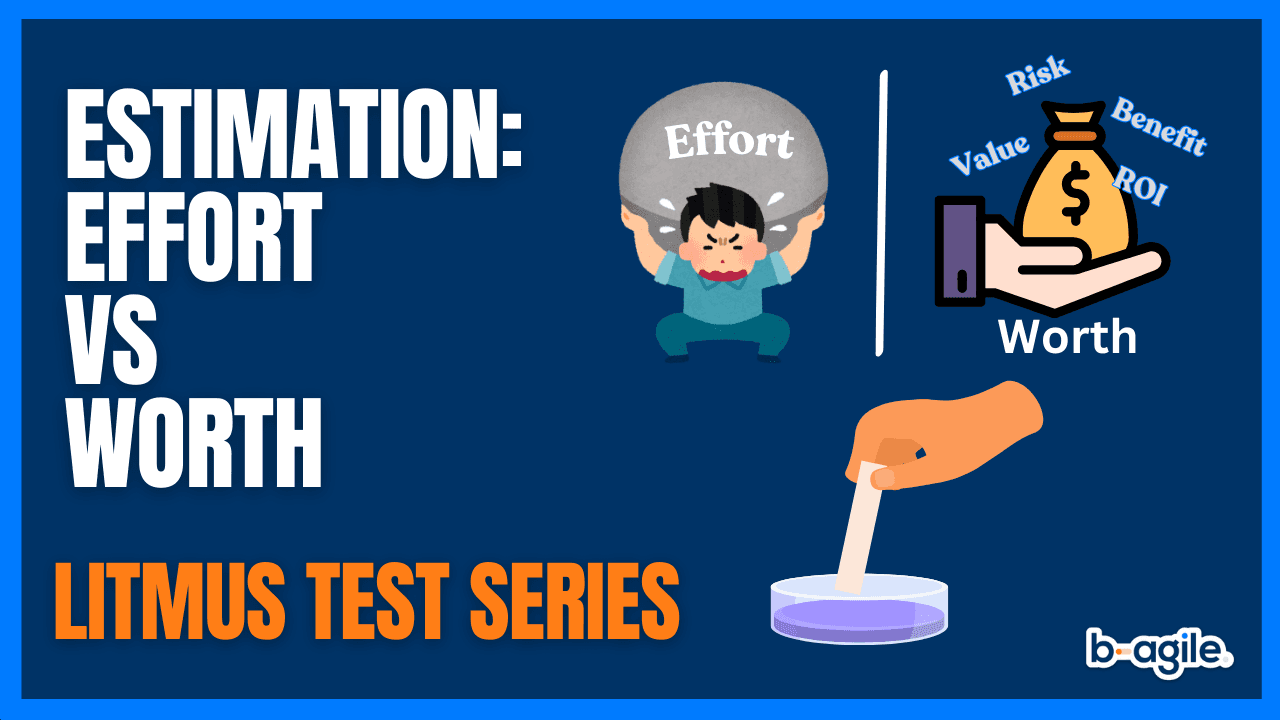
An estimate should help a team decide whether and how to do something, not predict a date. Teams that only estimate effort assume the work is already worth doing. The test is to ask what decision the estimate is meant to support.
You have probably sat in this meeting. A Product Backlog item comes up and the discussion jumps straight to effort. How big is it? How complex is it? How many points? Nobody asks the quieter, more important question: is this worth doing?
That is not a process failure. It is a thinking failure. In the previous post of the litmus series we looked at how people misuse velocity to create false certainty. Estimation suffers from a similar problem, for a different reason.
Why estimation becomes a problem
People usually treat estimation as a sizing exercise. We estimate how long something will take, how hard it will be and how much effort is involved. Those questions sound reasonable. They are also incomplete, because they assume the work is already valuable and that the decision to do it has already been made. In many teams, estimation happens after value has quietly been taken for granted.
The question
Ask a Product Owner, Scrum Master or delivery lead: "When the team estimates, what are you expecting the estimate to tell you?" Then listen carefully. To surface the thinking faster, follow up with: "What decision are you expecting to make based on that?"
The shallow answer
The first replies are usually single words: effort, complexity, size, time, story points. Given a little more room you hear sentences. We estimate so we know how long it will take. We estimate how much we can plan into a Sprint. We estimate to forecast delivery, so stakeholders know what is coming and the team can commit.
All of these reveal the same expectation, that estimation exists to turn uncertainty into commitment. They frame it as a delivery support activity, not a decision-making tool.
Why this misses the point
When estimation is only about effort, value is assumed instead of explored, trade-offs are skipped and risk is discussed late, if at all. Estimation becomes a gate you pass through, not a conversation you learn from.
Teams get very good at answering "How hard is this?" and very bad at answering "Should we do this at all?" That is how backlogs fill up with well-estimated work that delivers very little.
The genuine answer
People with a deeper understanding answer differently. They estimate to explore options, to understand risk and uncertainty, and to decide whether something is worth doing. Sometimes the estimate tells them not to build it at all. They also use it to align expectations, so the team and stakeholders can negotiate trade-offs and collaborate on value.
They usually make three things explicit. Effort only matters in relation to value. Estimation without value is just sizing. The goal is better decisions, not better predictions. At this level, estimation stops being a commitment mechanism and becomes a thinking tool.
Why this matters
When teams estimate effort in isolation, they optimise delivery. When teams estimate in service of value, they optimise outcomes. The shift is from "Can we deliver this?" to "Is this the best thing to do next?"
Estimation stops defending plans and starts supporting choices.
Making it real
Shallow estimation thinking sounds like this: "This is an eight-point story, so we'll need to plan it carefully."
Better estimation thinking sounds like this: "This looks expensive relative to the value we expect, and we're making assumptions. What are we actually unsure about? Is there a smaller way to test those assumptions and get feedback sooner? Is it small enough to justify spending another cycle of time and money on it? And if we don't do this now, what really changes?"
Same work. Very different decision.
The essence
One distinction reveals everything: effort versus worth. Effort tells you how hard something might be. Worth tells you whether it deserves the effort at all. Estimation that ignores worth becomes busy work. Estimation that explores worth enables judgement.
What to watch for
Red flags. They may be missing the point if they treat estimation as:
- just about points
- required before the value discussion
- a prerequisite for prioritisation
- about accuracy
- something teams should get better at over time
Green flags. They understand it if they talk about estimation as:
- a way to compare options
- a trigger for value conversations
- a tool for exposing assumptions
- a means to decide, not predict
- something that sometimes leads to not doing the work
One last thing
If estimation in your organisation feels heavy, slow or political, that is not because estimation is broken. It is because value is being skipped. Weighing effort against value is at the heart of product ownership, and we spend real time on it in our Professional Scrum Product Owner course.
If you want the practical side of estimating, start with Estimation isn't broken. The thinking might be.
Try it with your team
At your next refinement session, before anyone says a number, ask one question about the top item: "If we don't do this now, what really changes?" If nobody can answer, you have found the item to question rather than size.
The litmus series
- Velocity is a result, not a target
- Estimation is for deciding, not predicting (you are here)