


As simple as Little's Law is, it is an incredibly powerful tool for understanding the performance of queues over time. Understanding how your process behaves is fundamental to running it effectively and efficiently.
Little's Law explained
Little's Law is a theorem by John Little. It states that the long-term average number of customers in a stationary system, L, equals the long-term average effective arrival rate, λ, multiplied by the average time a customer spends in the system, W.
Instead of building complex mathematical models with many variables, a business can use a simpler, more flexible model like this one.
It is written as L = λW, where L is the average number of items in the system, λ is the average arrival rate, and W is the average time an item waits.
In other words, the average length of a queue in a steady state is the rate at which customers join it multiplied by the average time they spend in it.
Despite its apparent simplicity, Little's Law is powerful because the relationship does not depend on the distribution of arrivals or of service time. It holds for any service order or queuing discipline.
Applying it gives you a simplified analysis of a complex system by looking only at queue length and wait time, rather than a host of other factors. That simplicity is also why it is not often used in formal queuing theory: the analysis may be too simple to represent a queuing model accurately.
It still works well for overseeing ongoing operations. The three averages it relates are each a clear measure of how effective a process is, and any fault in the system will show up in at least one of them.
The notation:
- L is the long-term average number of customers in the system.
- λ is the long-term average effective arrival rate.
- W is the average time a customer spends in the system.
- L = λW is Little's Law.
In product development this is usually written as:
Work in process (L) = cycle time (W) × throughput (λ)
Throughput here is the long-term average effective departure rate, which brings us to the assumptions.
Little's Law assumes:
- Conservation of flow: the average arrival rate equals the average departure rate.
- All work that enters the system flows through to completion.
- The total number of items is roughly the same at the start and the end.
- The system is stable: the average age of items is neither increasing nor decreasing.
- All measurement units are consistent.
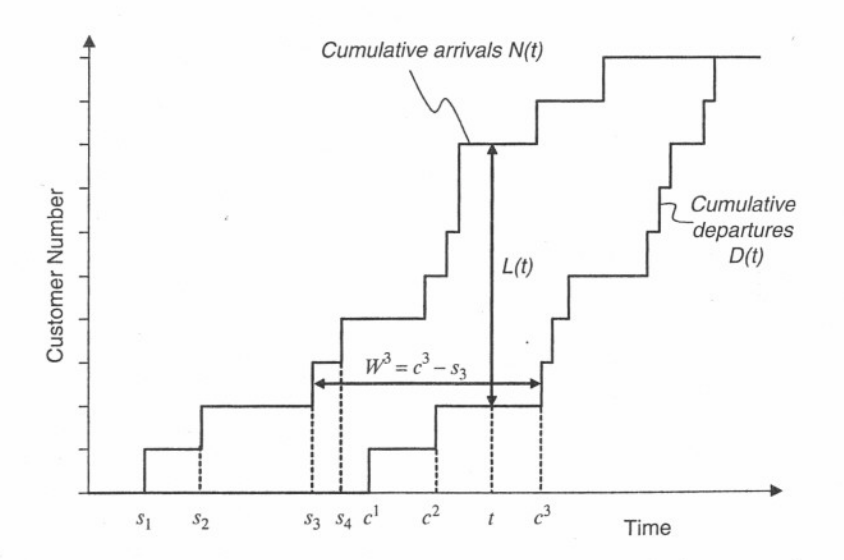
The calculation is exact, but only when those assumptions hold for the time period under observation.
Consider the following situation. Which assumptions are being violated?
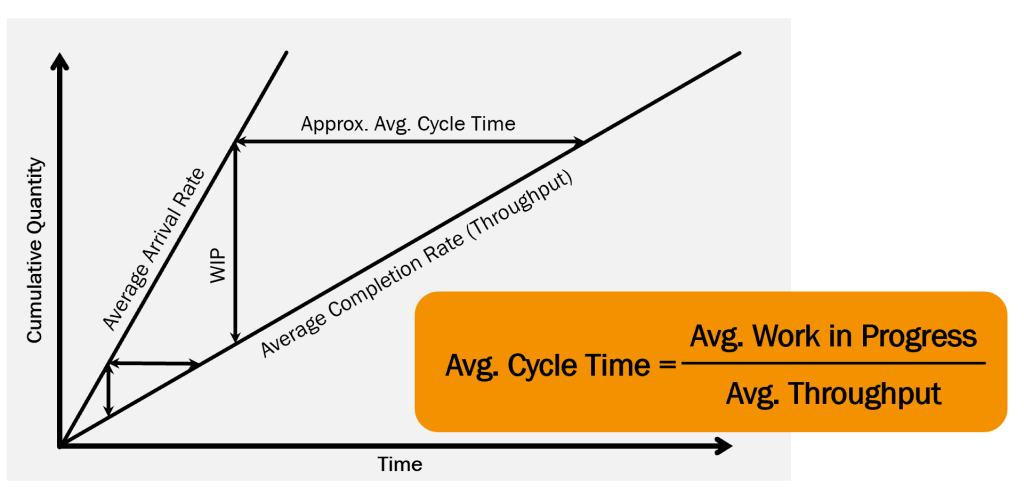
If we calculated two different time periods we would see wildly different results. That tells us the process is unstable and violates one or more of the assumptions.
The net effect of violating them is that you have destabilised your process, and the equation not working is the evidence. Stability matters because you cannot optimise a process that is inherently unstable.
Assumption 5 is obvious: use the same units. If throughput is per day, measure cycle time in days.
Assumptions 1 and 3 are equivalent. They are about stability, and they say nothing about how much work in process you should have.
Assumption 2 is interesting and often ignored. In many kinds of work we occasionally abandon items. Abandoning a lot of work is itself a sign of instability.
Assumption 4 is the most important. What Little's Law describes is that increasing the arrival rate increases work in process, which causes the work in the system to age.
Queues are everywhere: ordering food at McDonald's, the supermarket checkout, buying tickets for a popular gig, and every business and product development process. Little's Law applies to all of them.
Say you are in the queue at Starbucks. Little's Law can estimate how long it will take to get your coffee. Assume 15 people in the queue, one server, and two people served per minute:

You can expect to wait 7.5 minutes for your coffee.


Little's Law gives a simplified view of a complex queuing system, and we see the effect of any change in the long-term averages. What it cannot do is tell us what needs to change in the queue to optimise the flow of value.
For more, read Queuing theory and operations research.