

Agile isn't dead. It's misunderstood.
Listening to Jimmy Carr on The Diary of a CEO, his line "People crave the success, not the journey" struck a chord with me. It sheds light on a problem I see constantly: why Agile fails in organisations.
Many organisations jump into Agile without understanding why they are making the shift. They focus on quick results and overlook the journey of transformation that change demands. The misunderstanding is widespread, affecting whole organisations rather than a few individuals. The eagerness for success overshadows the essential work of realigning values and mindset. Embracing the full journey of change is what makes success last.
The notion that "Agile is dead" was popularised by Dave Thomas in his 2015 GOTO talk, where he critiqued how Agile had been commercialised and misunderstood. Thomas was not suggesting we abandon Agile. He was pointing out that the focus had drifted away from its core values of adaptability and delivering value.
Many people repeat "Agile is dead" without engaging with Thomas's talk or his post Agile is dead, long live agility, and miss his deeper message. We believe the same: the problem is not Agile, it is how organisations approach it. They concentrate on practices and not on the underlying values and cultural shift that true business agility requires. Understanding and embracing those values is what makes a transformation meaningful.
Business agility: beyond the practices
At b-agile we prefer the term business agility to Agile:
Would you like your organisation to achieve true business agility, with the ability to respond quickly to market change?
Are you interested in an approach that helps you maximise value and reduce risk, so you can build great products and services for your customers?
Agile is not a set of practices. It is a mindset shift. The move towards the Agile values and principles ultimately changes culture and leadership, and leads the organisation towards value-driven decisions.
Case study: ING's transformation. A great real-life example is ING, a global bank that transformed through business agility. ING built a culture of continuous learning and adaptation. By empowering small, cross-functional teams and encouraging experimentation, it became more responsive to market change in a highly regulated industry. Its success lay in continuously adapting and improving to deliver long-term value.
True business agility means embracing that journey, as ING did. It takes moving beyond rigid frameworks and empowering teams to keep improving and adapting.
The common pitfalls
Organisations struggle with Agile because of:
- Practices over values. Adopt the Agile values, not just the practices.
- Speed over learning. Focus on learning and delivering value early.
- One-size-fits-all frameworks. Adapt Agile to your needs.
- Ignoring culture. Leaders must model the Agile values for change to last.
There is more on these in Agile and Scrum: unravelling the misconceptions.
The project paradox: a shift in thinking
One of the most powerful moments in our Agile and Scrum courses is discussing and drawing the project paradox:
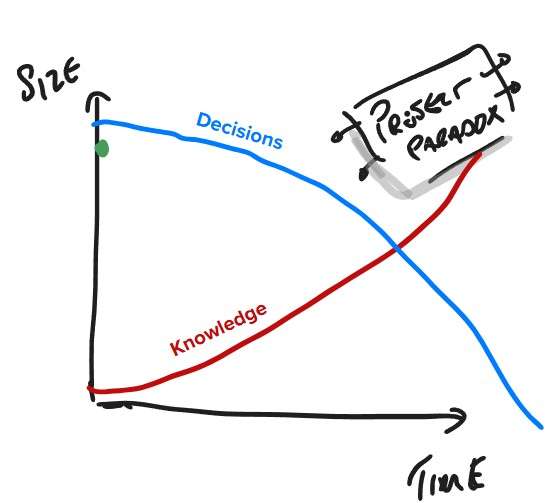
Why do we make the biggest and most critical decisions at the start of a project, when we know the least about what we are building? Why do we make the fewest decisions when we know the most?
Our follow-up question: "Have you ever worked on a project that was delivered on time, within budget and exactly as planned?"
The answer is almost always no. Yet organisations keep relying on a project-based approach that does not account for the uncertainty and complexity of building something new. That rigid mindset means missed opportunities to create real value.
To navigate the paradox, Product Owners need to grapple with the 3 Vs, vision, value and validation, and recognise that genuine value goes beyond output. Escaping the Product Owner's trap covers the shift from managing components to owning a product that delivers real value.
That shift aligns the organisation with customer needs. Value stream mapping is a key tool here, letting teams find bottlenecks and improve their workflow so they can focus on the outcomes that matter. See Where to start with Scrum? Is value stream mapping your answer?
The results-oriented trap
Back to Jimmy Carr: "People crave the success, not the journey."
Many organisations look at the results others have achieved with Agile, faster delivery and better responsiveness to the market, without appreciating the journey it took. They think they can copy the visible outcomes without the iterative process, the failures, the learning and the adjustments that shaped them. They also miss that true agility is not about speed. It is about a culture where continuous improvement, adaptability and delivering value become second nature.
Every organisation, and every team within it, is unique. You need to find what works for you and your teams. No cookie-cutter solution will do. Tools like Scrum encourage an empirical approach, so you inspect, adapt and keep improving until you find it.
It is not about delivering faster. It is about delivering value faster, learning from feedback, and pivoting when needed.
Agile requires an empirical approach
One thing organisations often miss is that Agile relies on empiricism. Successful agile teams test their assumptions, gather feedback and adapt on what works. The process is not fixed. It is fluid, and the team pivots as new information emerges.
Some parts of the organisation, such as HR, may not traditionally work in an agile way, but they benefit from aligning with the principles too. Lengthy hiring processes and slow approvals create bottlenecks that disrupt agility. By removing waste and reducing delay, HR can support an agile organisation without adopting every practice. Other areas that are predictable and repeatable, such as compliance or routine operations, may not need Agile at all.
A hybrid model may be part of the journey, but it should not be the destination. Mixing Agile with rigid frameworks limits the benefits, especially where responsiveness and flexibility matter most.
Our favourite courses for shifting this approach and starting the right conversations about outcomes and data-driven decisions are Professional Agile Leadership Essentials and Evidence-Based Management. Both help leaders adopt a more outcome-focused, empirical way of working.
Start with a reset: back to the why
Many organisations chase quick results and overlook the mindset shift Agile demands. Without alignment on the why, practices become empty rituals, and teams start questioning the value of the change.
That is why starting with a reset, a deliberate pause, makes all the difference. A reset is not just a stop. It is an opportunity to:
- Align with purpose. Teams benefit from a shared understanding of why they are embracing Agile. Purpose gives direction and meaning and makes the journey feel worthwhile.
- Inspire curiosity. Transformation can feel overwhelming. A reset lets leaders open conversations that help teams see opportunities rather than obstacles.
- Support change champions. The people who naturally embody the Agile values sustain momentum. They show others that autonomy, mastery and purpose are attainable.
Before diving into frameworks, reflect on:
- Why Agile matters
- The values it promotes
- How it enables business agility
Starting with a reset creates an environment where meaningful change can happen, and nurtures the autonomy, mastery and purpose that drive motivation and sustained progress.
Why people think Agile is dead
The claim that Agile is dead usually comes from misunderstanding. Organisations mistake Agile for a set of practices rather than a comprehensive mindset shift. They implement the practices without the values of collaboration, responsiveness and continuous learning, see no benefit, and conclude that Agile does not work. Agile is not dead. It is being misused.
Agile requires a shift in how an organisation operates. Without that shift, organisations struggle and revert to traditional methods.
The true nature of Agile
Agile is not rigid frameworks or prescriptive practices. It is a mindset in which the journey of learning, adapting and improving matters as much as the result.
At b-agile our mission is to make agility part of your organisation's DNA. We help you:
- Understand how Scrum, Kanban and DevOps enable agility when they are used correctly.
- Build the deep transformation that drives collaboration, continuous improvement and value-driven decisions.
If you are ready to go beyond delivery and embrace real business agility, get in touch. For leaders, the Professional Agile Leadership Essentials course is the place to start.
Go deeper
Professional Agile Leadership Essentials (PAL-E)
Put this into practice with the course that covers it in depth.
View the course