

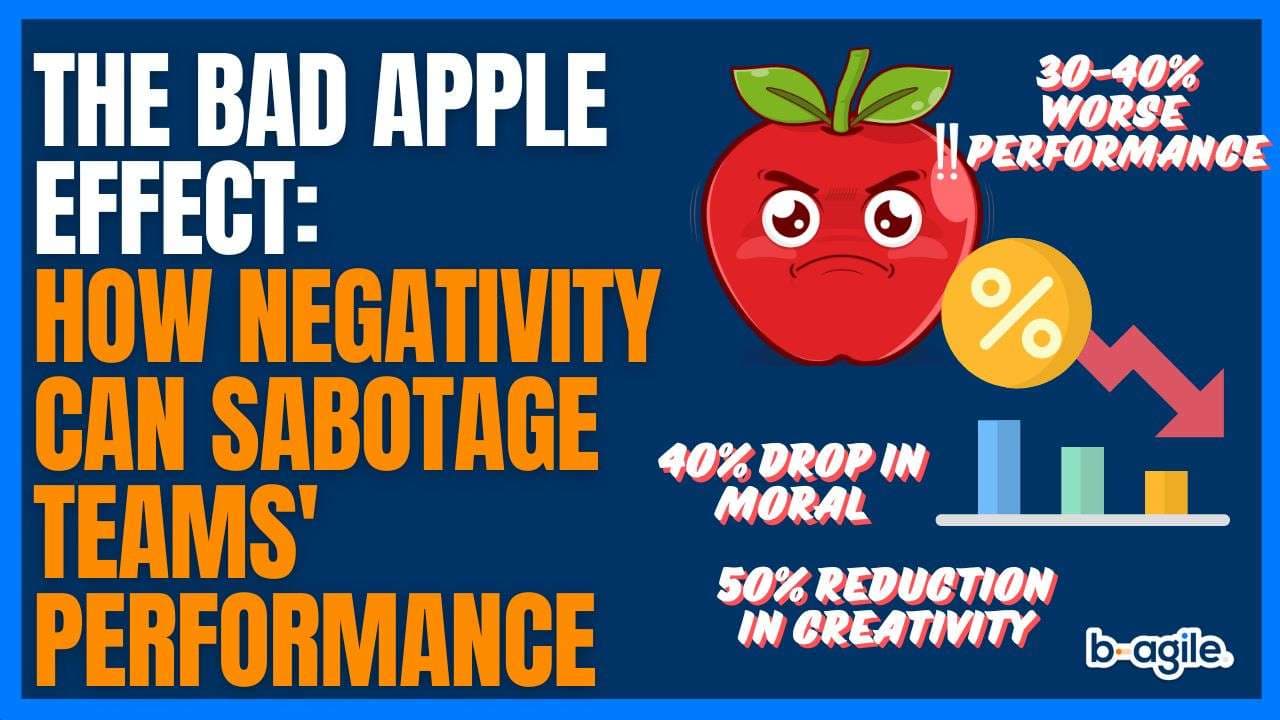
One person's negativity can pull down a whole team, even a talented one. Research led by Will Felps found teams with a "bad apple" performed 30% to 40% worse. Notice it early, talk to the person, and lead by example.
The bad apple effect can deeply sabotage a team's performance and development. I had an eye-opening experience outside work that showed me how much one person's negativity can damage a group. Both my sons play football, one at academy level and the other at grassroots. Despite the difference in level and commitment, the same troubling pattern emerged in both teams over time.
Even with talented, capable players, the teams often underperformed and struggled to progress. It was not a lack of skill or effort from most of the boys. Negative behaviour from a few players was affecting the whole team, in matches and in training.
That led me to look for published research on how negativity affects teams, and to a 2006 study known as the bad apple effect.
What the study found
The idea is simple. One person showing toxic behaviour, through laziness, constant complaining or being disruptive, can drag down the performance of an entire group. Watching the matches, it was impossible to miss all three behaviours among a few players, which is perhaps understandable in teenage boys. Those attitudes sapped the whole team's morale and teamwork, and most of the players, who were talented and hard-working, were overshadowed by the negative atmosphere.
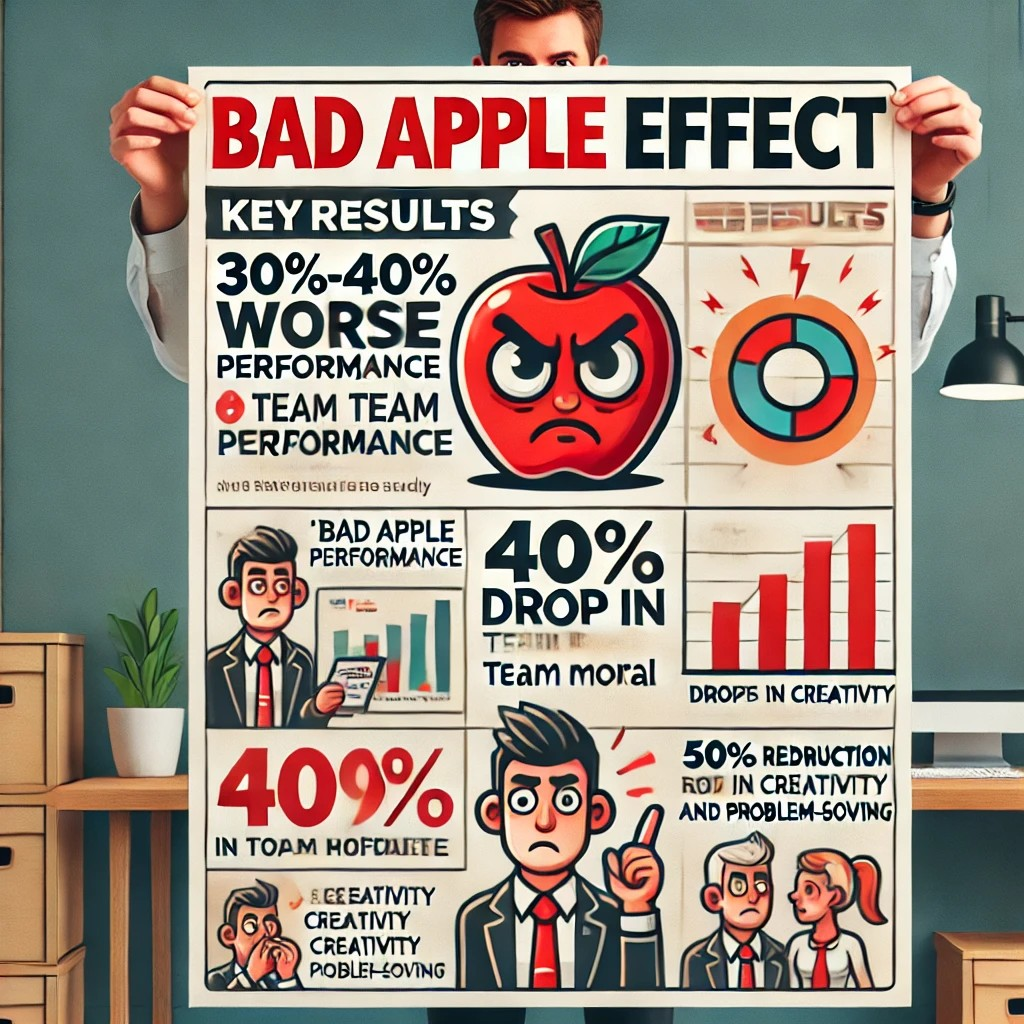
The study, led by Will Felps and colleagues, showed how a single bad apple could significantly reduce a team's output and morale. It identified three types of negative behaviour:
- The jerk. A team member who is consistently critical or disrespectful of others.
- The lazy person. Someone who disengages and does the bare minimum.
- The complainer. Someone who is always negative about outcomes or the team's chances, sapping motivation.
I saw all three on the pitch: the players who constantly criticised others, the ones who seemed disengaged, and the ones who were always pessimistic about the team's chances.
One person's bad attitude becomes a team-wide problem.
What is striking is how contagious it is. I have long said, before reading the study, that negativity sucks the energy out of a team, and the matches confirmed it. One boy's disengagement quickly spread, dampening everyone else's energy. The whole team got sucked into a downward spiral and, despite having everything they needed to win, could not deliver.
Have you seen this play out, in your workplace, on a team you have coached, or in a casual setting? It is hard to see at first, but once you notice it the signs are clear. Even the most enthusiastic members begin to underperform or disengage.
The facts
The research is often summarised with one eye-opening number, widely reported from Will Felps's work:
- Teams with a bad apple, one member showing negative behaviour, performed 30% to 40% worse than teams without one.
- Even a team of high performers suffered a significant drop in productivity and cohesion when one negative member was introduced.
That shows how powerful and damaging one person's influence on a team can be, in sport or in a delivery team.
Agile leadership, for example, takes more than following the practices. It takes the right mindset, and the right people "on the bus", as Jim Collins puts it in Good to Great. Agile thrives on collaboration, continuous improvement and its core principles and values. Practices and tools like Scrum and Kanban help teams live those values, but no amount of process overcomes unchecked negative behaviour. It is not just about the skills each person brings, but their mindset and how it shapes the team's dynamic.
Negativity in agile and Scrum teams
Helping teams adopt Scrum or shift to an agile way of working, I have seen negativity arise from deeper issues than a misunderstanding of the principles. Often it comes from holding on to outdated ways of working, such as focusing on projects instead of outcomes, or neglecting the practices that continuous learning and improvement depend on. The result is frustration, disengagement and resistance.
Common sources include:
- Focusing on outputs instead of outcomes. Teams that stay project-focused rather than outcome-driven get frustrated. The shift to outcomes, supported by a framework such as Evidence-Based Management, is challenging but essential for long-term success.
- Leadership that does not enable self-management. Agile leadership means creating an environment that empowers teams to self-manage, with clear goals and accountability. Leaders who cling to command and control breed negativity and make it harder for teams to grow and collaborate.
- Neglecting continuous learning and improvement. Teams that do not embrace continuous improvement stagnate. Agile thrives where learning is constant and teams adapt on feedback and inspection. Without that, frustration sets in.
- A lack of technical excellence and a quality-first mindset. Neglecting modern technical practices such as continuous delivery and Extreme Programming creates a performance gap. Without technical excellence, teams struggle to deliver value consistently, and disengagement follows.
Each of these is damaging if left unaddressed. Overcoming negativity takes a shift in mindset and practice: outcome-driven work, continuous improvement and technical excellence. When a team understands the why, embraces change and focuses on delivering value through learning and quality, it is far more likely to thrive.
How to tackle negativity in a team
If you are facing negativity in your team, whether it relates to Agile, Scrum or anything else, there are four steps to take:
- Encourage open communication. Make sure people feel heard and valued by creating space for feedback. It surfaces issues early, before negativity festers. See Building healthy team relationships using great feedback.
- Address negativity early. Do not let toxic behaviour go unnoticed. Tackle it head-on through one-to-one conversations or coaching, to understand the root cause and help the person shift their mindset.
- Foster continuous learning. Negativity often comes from preconceptions or misunderstandings about agile principles and practices. Create opportunities for deeper learning. A clearer understanding of the core values and practices reduces frustration and resistance.
- Lead by example. As a leader or coach, modelling positive behaviour, collaboration and a growth mindset inspires others to do the same and limits the impact of negativity.
The bad apple effect is not limited to sport or business. It shows the universal impact of unchecked negativity. Recognising and addressing the behaviour is crucial to preserving morale and performance, most of all in agile environments, where collaboration and self-management are essential.
Try it with your team
Think of a team you have been part of. Which of the three behaviours, the jerk, the lazy person or the complainer, did you see, and how did the team respond? Share it with a colleague, then pick one of the four steps above to try this week.
If negativity is holding your team back, our agile coaching can help you build a stronger, more adaptable team. For leaders, the Professional Agile Leadership Essentials course is the place to start.